

The Power of Story
The team sat glued - time had lost its importance! What had us captivated was a story, not any story but the story of a young lady who had persevered through a trial of immense proportion. We had invited M... to come and share with us as a team, six days after her release.
Claiming innocence yet sentenced to seven years. We saw this young mum and her baby enter the prison and begin the long journey. From dislocation, separation, humiliation and grief; so much lost yet, in the darkest of places the discovery of a new hope and abiding fellowship in Christ that became a strength to her, and her family.
We listened to the journey of learning how to be thankful in the face of crushing discouragement, gratitude in the face of loss, worship in the adversity of rejection. In spite of the roughness of the prison, God filled her with a gentle and quiet spirit that became a strength to so many of her fellow inmates. Her actions in faith were inspiring and real.
Listening, we also saw that the raw pain of the long struggle was real and there were many tears shed and shared in the re-telling. Being a new mother inside prison added to the challenges that she faced. This lady served five years and nine months before being acquitted of all charges and finally walked free. But freedom is only the beginning of a new struggle around the realities of now rebuilding life, livelihood and relationships.
What we celebrate is the secure foundation she found in faith and how that was activated in her day-to-day life. What M... celebrated was how the OF Team supported her with relationship, integrity, and consistency. Without M... being aware these are three of our core values that had been active in her ongoing support and growth.
Listening to M...'s story has provided the team with deeper insights and renewed joy in God's redemptive story. We share it with you as an encouragement of all that God is capable of doing in a young woman's life, who came to prison worshipping idols and left sharing the testimony of the reality of Jesus Christ.

And The Blind Will See
Statistics show us that the overwhelming majority of women and men in prison have suffered significant trauma in their lives. Most often this negatively impacts behaviour, attitudes and relationships. The team have just finished facilitating two Trauma Healing Groups in the prison on Taveuni Island. Here is a testimony of one of those men who has now recovered his spiritual sight.
Name: P... | Age: 52yrs | Vanua: Island of Koro
There were nine of us siblings altogether and I was the middle child. I was also the smallest of all my brothers and sisters. My father rejected me and I was left to fend for myself from a very young age. I had to look for my own school fees and bus fare, often resorting every Saturday to my skills as a coconut gatherer and copra cutter. I was often called names, some even saying that I was not from the Island. These things hurt me deeply.
Because of all this, I decided that I was going to run away from the village by taking the next boat out. I left for school one morning and crossed over the island to where the boat from Suva normally berthed and went on it never to return.
When my parents and siblings found out I was already on my way out. I worked on the boat for 6 years – Suva, Levuka, Koro, Savusavu.
I joined Fiji Pine in Lautoka for 5 years. I thought I would be relieved of this pain I felt, by joining this new venture, but there was no relief. I had friends and was able to afford things, but they gave me no peace. I worked for the Coral Reef, a New Zealand company for 3 years, but it did not bring me the peace I sought.
I worked for a Backpackers Resort for 19 years and had my share of money, women and booze but they did not satisfy me one bit. It was in this situation that the whole thing blew up on me and I ended up in prison. Now the very thing I wanted the most that set me out on my journey from my island of Koro – FREEDOM, was taken away from me.
When I finally heard what was being taught/shared in the class these few days, I then realised that I was trying to suppress my suffering and all the pain and the hurt from being rejected by my own family, especially my father. The class has made me aware of the issues of heart wounds and the steps of personal responsibility and forgiveness to begin to be healed.
I did not think I can do this, but I am able to share my life story because of the freedom I now have in Christ! The class has really helped me look at my situation in a new and healthy ways – I have a new beginning!
When Jesus said in Luke 4:18-19 that He had come to give recovery of sight to the blind, it is men like P... who cry out in worship as they see past their bondage and pain, to new freedom in repentance, forgiveness, reconciliation and renewal.
Celebrate with us and P... his spiritual awakening, and thank you for the support that has made his testimony possible.
He Eats With Sinners
The accusation was meant to condemn, and from that condemnation would hopefully emerge widespread rejection. ‘He eats with sinners’, was attempting to establish the familiar ground of ‘us and them’.
What was so shocking was that one who called himself Son of God, Holy, and Righteous, was willing, in fact making a habit of being in the company of them, those from the rough and despised part of society.
That battleground was historical and I can read the scriptures in that same historical way. But I can see the same patterns re-attempting to strangle the strength of our gospel even today?
When I was in prison, I came to realise that the appeal of Jesus was universal. Many of my fellow prisoners understood the reality and hope in that simple accusation, ‘He eats with sinners’. It spoke to a hope that somewhere in all their confusion and mess Jesus was for them, he was accessible.
In their understanding, Jesus was definitely confronting, but his humility was as attractive as ice cream on a hot day. In fact, Jesus Christ’s humility was beautifully prohesied, not as ice-cream, but as being so gentle he would not bruise a reed, and as we read the gospel account we see the fulfillment of that.
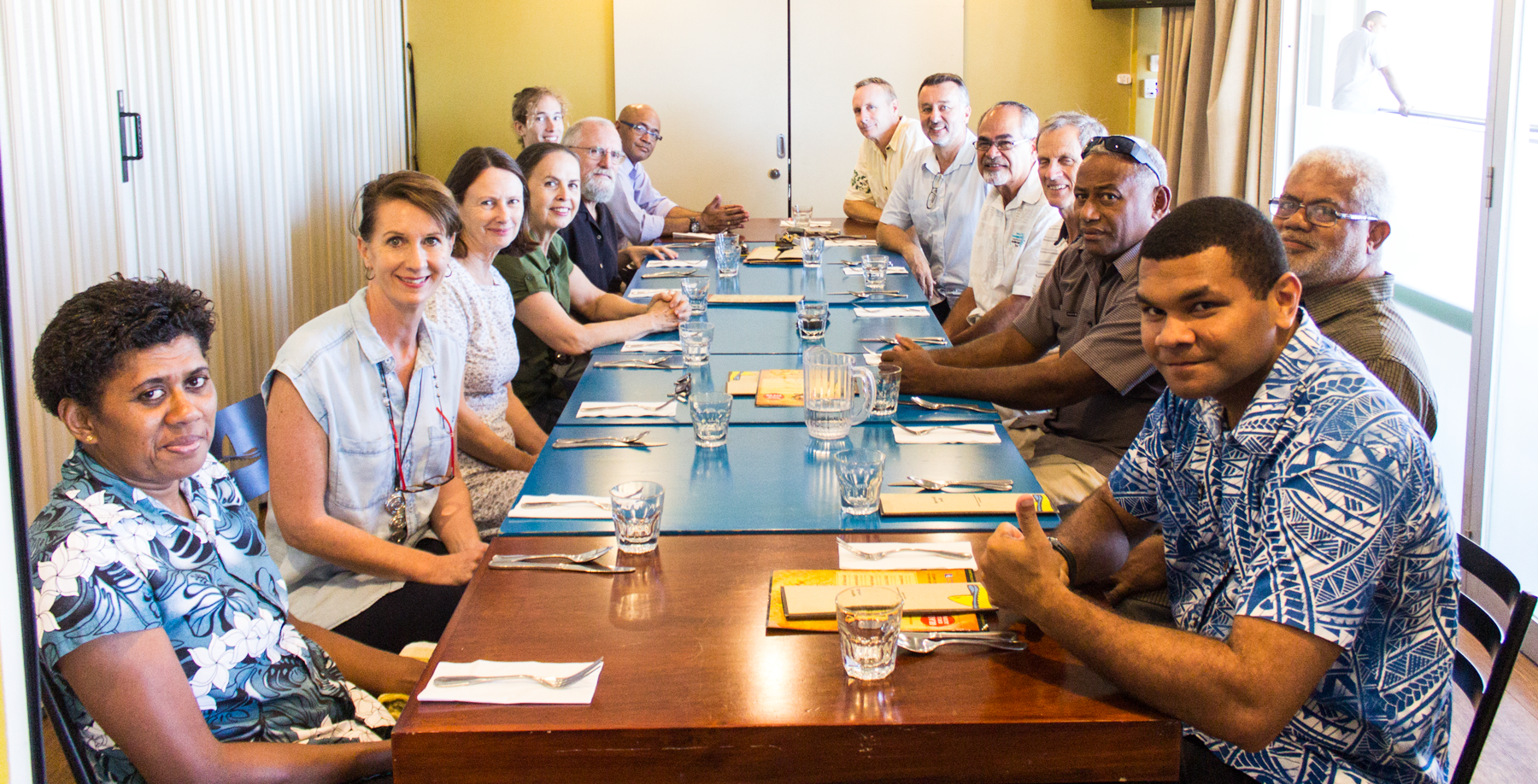
This humility is what we as team aspire to. It is one of our core values and leads us on many occasions to pull up a chair at a table and eat with sinners. But if humility and witness could be established just by eating together then I’d just be asking for second breakfasts.
The story from which we read of this accusation against Jesus is recorded in three of the four gospels and references both tax-collectors and sinners. Matthew, Mark, and Luke knew the importance of the telling of this accusation, its importance for what it revealed then, and perhaps also for what it reveals about our religious systems now.
I believe the accusation was more aimed at Christ’s posture and purpose than the actual sharing of a meal together. To eat a meal with someone down-trodden, someone in a lesser position, is often seen to be good - a good deed. However, the accusation was meant to redefine what was becoming attractive, even perhaps what could have become a new normal.
We are now in the time of Lent, where we are encouraged to forgo something for the purpose of a greater focus on Jesus Christ and his ultimate sacrifice. As you fast can I also plant the idea of taking up a sacrifice of mercy.
Will you throw open your table, fire up the BBQ, break out the wine, and invite sinners into your presence? There is no greater time to introduce Christ to a world that is becoming fascinated by the idea of ‘us and them’.
Jesus is attractive to sinners when we, as hosts of the gospel, make ourselves accessible in our common settings.
And as Jesus reclined at table in the house, behold, many tax collectors and sinners came and were reclining with Jesus and his disciples. And when the Pharisees saw this, they said to his disciples, “Why does your teacher eat with tax collectors and sinners?” But when he heard it, he said, “Those who are well have no need of a physician, but those who are sick. Go and learn what this means: ‘I desire mercy, and not sacrifice.’ For I came not to call the righteous, but sinners.” Matthew 9:10-14
Peter Schultz
Class 35 Stretches Everything
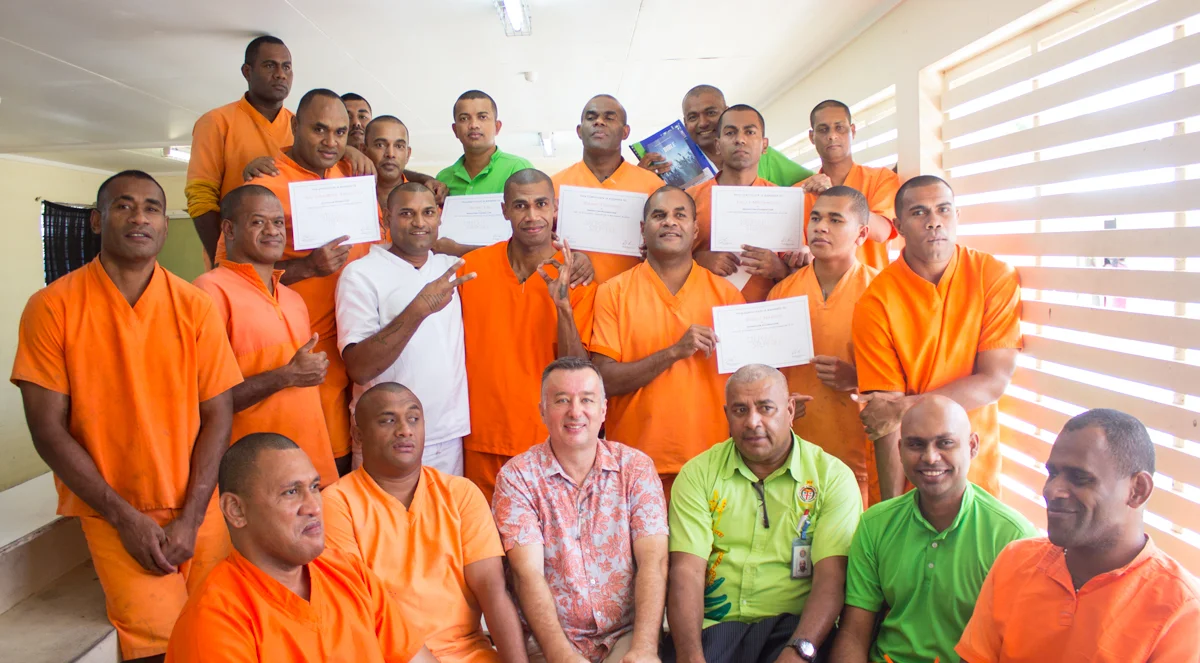
The agreement, as we understood it, was to be thirteen men, however as we looked at the classroom filling up we counted twenty two. A brief discussion followed, and our commitment became the twenty two men expectantly sitting in front of us.
Immediately, our minds were filled with the reality that building trust and creating the necessary vulnerability was the task at hand. We knew how to achieve it with a smaller group, but what would it be with a larger group of men, long serving inmates no less?
A normal StepOut-StepFree class takes 2 weeks. This class, SOSF Class 35, took a month, as we deliberately slowed it down to allow more time for discussion, reflection and the building of the community essentials.
As the days progressed we began to observe genuine interest: a taking hold, an embracing of the self-confrontation, and questions - so many questions opening into wonderful discussion. During this same time, the strength of worship changed to where the voices now blended, harmonised and became the beautiful praise of broken men - new community was being built!
One of the men had served 17 years - having entered incarceration at 14 years of age. StepOut-StepFree was the first program he had undertaken, and it was by his choice. We observed the scales falling from his eyes, a new hope, a new understanding, a new countenance.
Several other men testified to becoming 'unburdened' during the days, and we could see that take place before our eyes. Our fear of taking on such a large class was replaced with a faith that God can accomplish so much more.
Final words belong to one man who wrote, 'StepOut-StepFree is a signpost, a lighthouse. I mean to say like air that I can now breathe after the confusion that had become my life.'
Providing these men the space in which to encounter their lives, their past, their future is a sacred trust. Our collective thanks goes to so many of you, our partners, that provide the resource and prayer to make this all happen again and again.
Peter Schultz


The role of spiritual formation in rehabilitation?
A couple of years back I found myself having coffee in Suva with a Dutch criminologist discussing his studies in how juvenile delinquents make their decisions. It was rich conversation
A couple of years back I found myself having coffee in Suva with a Dutch criminologist discussing his studies in how juvenile delinquents make their decisions. It was rich conversation and as he talked about his research and what was showing up in the findings I interrupted him to say – ‘much of what your findings are showing have a parallel in scripture and in Christian faith and practice’. The conversation took another rich turn suffice to say that there is a heady mix of questions, argument and debate in what role, if any, spiritual formation plays in the rehabilitation of people, prisoners in particular.
The questions often collect around the very simple themes of:
- the nature of man?
- what brings change to the human condition?
- and what sustains change in our human behaviour?
Dallas Willard wrote an essay that became a lecture given at the Talbot School of Theology in 2008. Willard spoke of pornography and spiritual formation, providing powerful insights into what shapes the heart and mind leading into and away from the desert of pornography. In his essay 'Beyond Pornography', Willard makes the case that everyone, no matter how degraded, has had spiritual formation boldly stating that, 'a person who is engaged or involved in pornography is so because of their spiritual formation'. Willard goes on to define spiritual formation in referring to 'how the basic elements of human life - the will, the thoughts, the feelings, the body, the social relationship, and the depths of the soul - have been shaped so that character and life come out of how they have been shaped'. Willard's contributions to our understanding of spiritual formation are compelling even though he is using pornography only as a single but highly relevant example.
As we look further to how others have made contributions to this debate we discover that Amy Levad who has written a compelling work in 'Redeeming a Prison Society - A Liturgical and Sacramental Response to Mass Incarceration'. Her approach built richly in the understanding of Imago Dei (man in the image of God) confronts our understanding of justice and spiritual care of those in prison, while building a considered argument for the place of the sacred (spiritual formation) in building a new person, a new framework and a new response.
Turning to our own limited work, in an Oceanic and community cultural setting, we continue to see the power of enacting a spiritual formation to bring and sustain personal change. Our practice underscores the critical importance of spiritual formation in rehabilitation.
Charles Taylor has made some significant contributions in our understanding writing in his highly regarded work, ‘Sources of Self - the making of the modern identity’, that the essential frameworks of values, as provided by faith and religious tradition, are critical in both knowing and forming who we are, who we know we are, and by what standards we identify what is good and subsequently form our 'good life'.
In developing Taylor's and others contributions, a crime problem is essentially both a sin problem and a spiritual formation problem. An enquiring approach that allows us to share the linguistic, connecting crime, sin and spiritual formation, also finds a permission to explore the powerful redemption pathway offered in the gospel. However if we accept such a linguistic connection and a spiritually formed solution then we arrive at the new problem of who then is best equipped to rehabilitate?
The problem and the challenge is that as a church we seem to have significantly disengaged the prisoner from our gospel, care and formation focus. By our silence we appear to be giving consent to the fact that redemption and rehabilitation is to be found in incarceration, not by a Saviour and the supportive response of His followers. We seem to have bought into the cultural and political response of 'law and order' thereby dismissing the underlying spiritual human need that cries out to us from the one who is 'hungry and thirsty'.
What are our fears - that the gospel is not powerful enough to effect change in prisoners? That we are not equipped to deal with sin and its effects in the small communities we gather together in called church. That my need for security and comfort outweighs the command to 'go and make’, which by implication necessitates risk and certain discomfort!
As I listen and talk to the passionate secular voices currently engaged in the field of rehabilitation, the critical challenge emerges that we need to better understand how to engage our spiritual and prophetic voice - and most importantly to walk the talk of our faith and redemption and to learn how to spiritually care for the souls given into our care!
Peter
Quoted: 'Beyond Pornography' - Journal of Spiritual Formation & Soul Care - Institute of Spiritual Formation, Biola University: Journal Spring 2016 Volume 9, Number 1

Water - More than just for washing!
Water – the beauty of this simple ingredient!
Clear, refreshing and vital to the sustaining of life as we know it, critical to livelihood and essential to thriving communities and nation building.
Water – the beauty of this simple ingredient!
Clear, refreshing and vital to the sustaining of life as we know it, critical to livelihood and essential to thriving communities and nation building.
Recently we visited Tutu, a Catholic training farm on Taveuni Island. The farm is blessed with a pristine natural water supply that is being captured as it cascades down the mountainside and directed through a turbine generating a constant 80KW electricity supply. Water sustains so much of the life and development at Tutu.
At the end of the Feast of Tabernacles, with its 7-day water ceremony and prayers for rain, Jesus stands and gives a declaration “If anyone is thirsty, let him come to Me and drink. Whoever believes in me, as the scripture has said, streams of living water will flow from within him.” John 7:37-38
The significance of this statement would not have been lost on the audience as they spent the last day of the feast in prayer and reflection. Jesus commands a freshness to the understanding of water as he urges us into a new perspective, pointing to something of a deeper nourishment. Living water – water that never runs dry, and quenches a thirst forever. Can I grasp the significance?
In our context of rehabilitation what does this theme and declaration speak? What is it to imagine the prisoner who has grasped for dry and dying things suddenly being filled, not just filled, but overflowing with living water – the significance of the life of Christ bringing into existence new things.
We have seen this; we have evidenced this! This is no mere chasing after the wind but a renewal of heart and spirit that is a step into the harmonic movement of God’s grace. The celebration of this lives long as we remember different names and occasions where this living water has birthed.
Earlier in history God speaks through Jeremiah a rebuke, “My people have committed two sins; they have forsaken me, the spring of living water.” The second part of God’s accusation is that we “have dug our own cisterns, broken cisterns that cannot hold water.” This is a blunt condemnation and one that requires us to pause in long reflection to ask honestly “where have I forsaken you and constructed my life in such ways that it cannot hold your water?”
The two statements link together – the incredible promise of streams of living water and the condemnation of the life purposefully and proudly built broken. Where is our life focused?
As a team we do pray that in prisons, and in families, and in communities, we would turn in the act of repentance toward God and see more of emptiness becoming filled with living and renewing water.
Peter Schultz